
What Mediterranean Fashion Week Taught Us About the Future of Fashion
From Lecce to Taranto, Mesagne, Bari and Vieste, Mediterranean Fashion Week 2026 offered a different idea of what a fashion week can be.
Fashion weeks are usually associated with a city: Paris. Milan. London. New York. Their identity is built around a concentrated geographical centre where designers, buyers, media, institutions and creative communities come together. Mediterranean Fashion Week 2026 proposed something different.
Instead of asking the fashion world to come to one central venue, it took fashion across an entire region — moving through Lecce, Taranto, Mesagne, Bari and Vieste between 1 and 5 September. The result was not simply a sequence of runway shows. It was an attempt to connect fashion with place. And that may be the most interesting aspect of the project.
Five cities, one Mediterranean narrative
The fourth edition of Mediterranean Fashion Week, conceived by Marianna Miceli, brought together more than 200 international guests, participants from around 20 countries and more than 50 international brands. Designers and creatives arrived from countries including Kazakhstan, Georgia, Uzbekistan, Turkmenistan, Kyrgyzstan, India, China, Morocco, Argentina, Portugal, Croatia, Bulgaria and others.
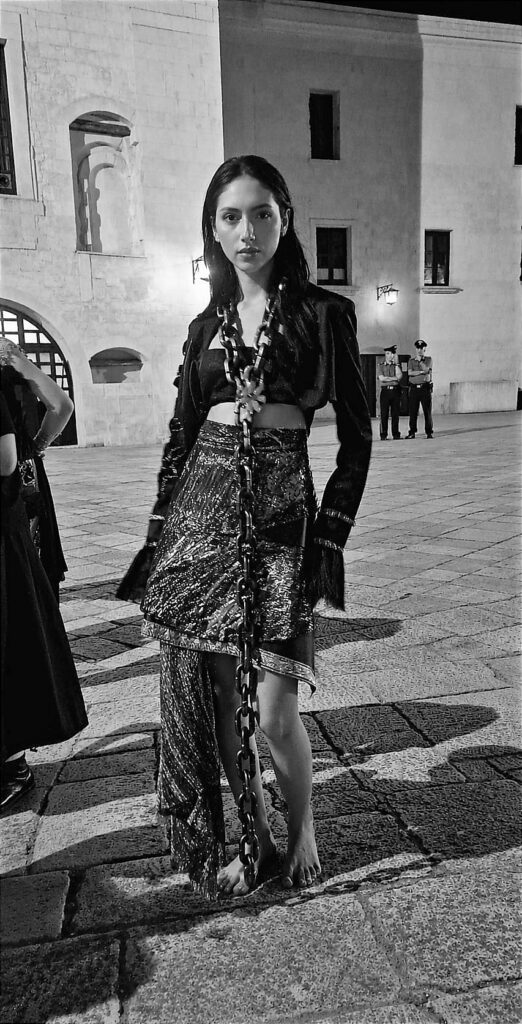
But the international character of the event was not separated from its location.It was deliberately placed within the cultural landscape of Puglia.The opening took place in Piazza Sant’Oronzo in Lecce. The second evening moved to the Castello Aragonese in Taranto, coinciding with the XX Mediterranean Games, where the fashion week was presented as a related cultural event. Mesagne followed in Piazza Orsini, Bari hosted the fourth stop, and the programme concluded in the historic centre of Vieste.
The geography was therefore part of the event itself.The cities were not simply backdrops.They became part of the narrative.
Fashion outside the traditional centres
There is something particularly significant about this model at a time when the fashion industry is becoming increasingly global. For decades, the international fashion system has been structured around a relatively small number of recognised capitals. Talent exists everywhere, but visibility does not.
Mediterranean Fashion Week approaches the problem from another direction. Rather than attempting to reproduce Paris or Milan in another location, it builds its identity around Puglia and the Mediterranean. That distinction matters.
A regional fashion week does not necessarily need to become a smaller version of an established fashion capital. It can create value precisely by offering something those capitals cannot reproduce: a specific cultural landscape, history, craftsmanship and relationship with place.
From runway to territory
The organisers positioned the event not only as fashion, but also as a vehicle for territorial promotion under the #WeAreInPuglia identity. The programme included off-catwalk activities, urban routes, exhibitions, talks and lifestyle initiatives involving local businesses.
This makes the event part of a wider cultural strategy.The runway becomes a point of entry. Around it, the city, its businesses, architecture, crafts and cultural identity become part of the experience.
This is particularly relevant for a region such as Puglia, where the visual identity of the territory is already extraordinarily strong. White stone, historic squares, Baroque architecture, coastal landscapes and centuries-old craft traditions provide a setting that cannot be separated easily from the fashion presented within it. The question then becomes less where can fashion be shown?
And more: What happens when the place itself becomes part of the fashion narrative?
Where craftsmanship meets international fashion
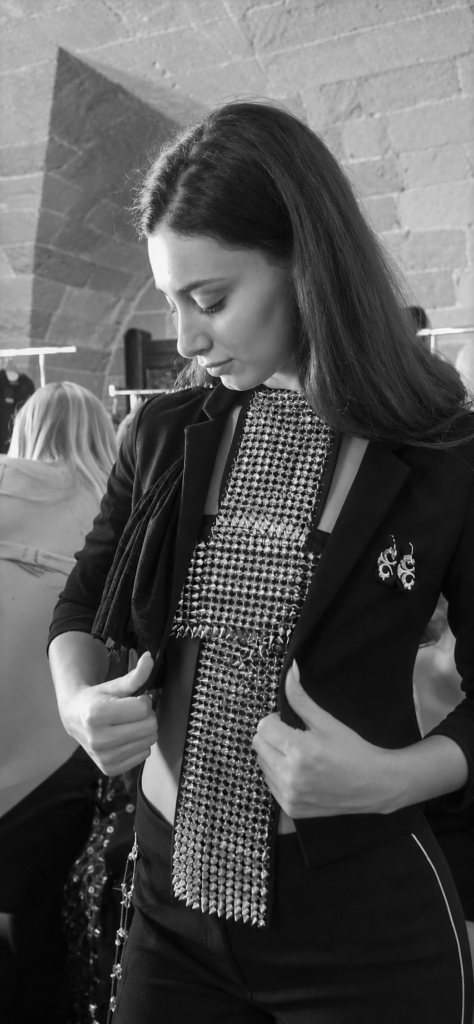
Another important dimension of this year’s programme was the emphasis on craft and design.From 2 to 4 September, Lecce hosted the International Craft & Design Festival in Piazza Sant’Oronzo, developed with the Eurasian Council for Craft and Design. The initiative brought together master artisans and designers from Central Asia and the Caucasus, presenting textiles, embroidery, felt work, ceramics, jewellery and other forms of traditional and contemporary craft.
This created an interesting cultural connection. The Mediterranean was not presented as an isolated creative territory. Instead, it became a meeting point between different traditions — including those historically connected through the Silk Road. In that sense, the event’s internationalism was not simply about the nationality of the designers.
It was also about the movement of techniques, cultural references and forms of craftsmanship between regions.
A Mediterranean fashion identity?
This raises a larger question. What exactly does “Mediterranean fashion” mean?
There is no single Mediterranean aesthetic. The Mediterranean is not one culture but a collection of histories, languages, religions, communities and visual traditions connected by geography and centuries of exchange. That complexity could actually become one of its greatest creative strengths.
Rather than defining Mediterranean fashion through a fixed visual formula — linen, white architecture, earthy colours, coastal imagery — the concept could be understood more broadly. Mediterranean fashion could become a conversation between heritage and contemporary design. Between local craftsmanship and international creativity. Between established traditions and emerging voices. And between the places traditionally recognised by the fashion system and those still seeking greater visibility.
A different model of the fashion week
This is perhaps where Mediterranean Fashion Week becomes most interesting. Its significance does not depend solely on the individual collections presented during the week. It lies in the model: a fashion week does not necessarily have to exist inside a single permanent fashion capital.
It can move. It can connect cities. It can use cultural heritage as infrastructure. It can bring international designers into dialogue with local communities and artisans. And it can make the territory itself part of the creative proposition.
The five-city structure of Mediterranean Fashion Week demonstrates how fashion can function as a form of cultural diplomacy: not simply presenting clothes to an international audience, but creating encounters between designers, countries, traditions and places.
Beyond the runway
The future of independent fashion weeks may depend precisely on this ability to offer something that the established capitals cannot. Not another imitation of the same fashion system. But another perspective on what fashion can represent.
Mediterranean Fashion Week 2026 placed international fashion within the cultural landscape of Puglia and showed that fashion does not always need to travel to where the established fashion system tells us it matters. Sometimes, the fashion system needs to travel elsewhere. To places with their own histories, their own crafts, their own visual languages and their own stories to tell. Because the future of fashion may not be about creating another fashion capital but about creating more places where fashion can become meaningful.