
A$AP Rocky’s AWGE: anti-military aesthetics beyond dystopian spectacle
Fashion has repeatedly borrowed from the visual language of conflict. But what happens when a collection uses the codes of military power not to glorify the soldier, nor to imagine the end of the world, but to expose the contradictions of the world we already inhabit?
Military aesthetics have long occupied an uneasy place in fashion. Uniforms, camouflage, tactical details and protective outerwear move between function, rebellion and luxury, often losing their original meanings in the process. They become silhouettes to desire, symbols to appropriate, and visual shorthand for a world imagined to be under threat.
With Anti-War Global Economics, the Spring/Summer 2027 collection by A$AP Rocky’s AWGE, this tension becomes the central proposition. Presented in Paris on 30 September 2026, the collection places military codes within a wider visual language of money, oil, street culture and high fashion. Its title suggests a political position, while its clothes resist the simplicity of a conventional manifesto. The most interesting question, however, is not whether fashion can look anti-war. It is whether it can engage with the aesthetics of militarism without becoming trapped in the familiar imagery of dystopia.
Beyond the dystopian uniform
The contemporary fashion imagination often approaches conflict through a recognisable visual vocabulary: distressed surfaces, tactical equipment, camouflage, gas masks and silhouettes that suggest survival after social collapse. These references can be powerful, but they have also become predictable. The imagined future is frequently reduced to a wardrobe for a world already destroyed.
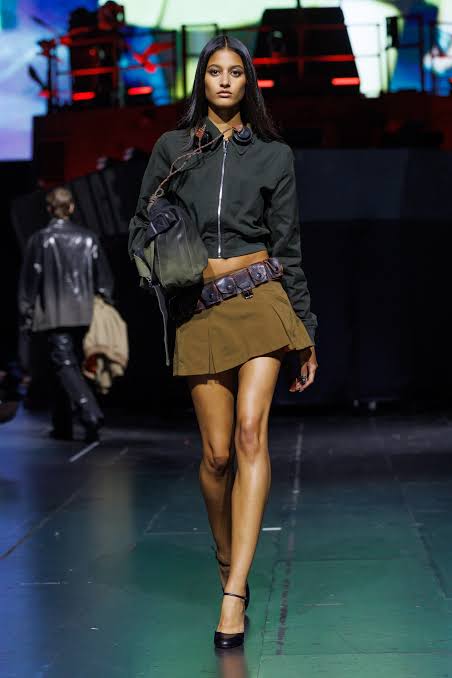
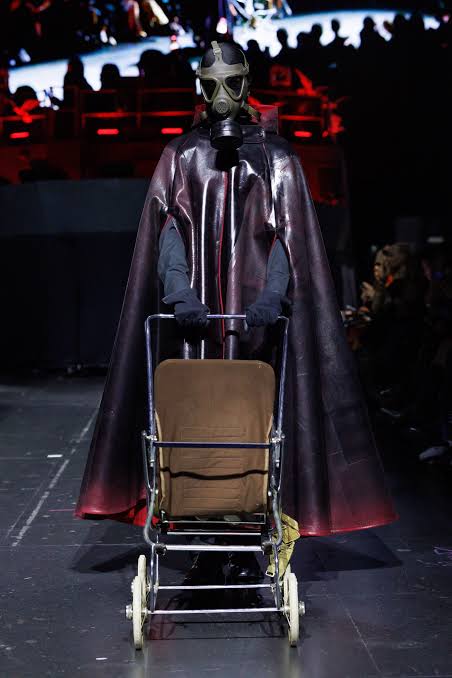
AWGE works with many of these same codes. Tactical vests, cargo trousers, flight caps, military-inspired jackets and gas-mask imagery appear within a show staged around a monumental ship. Yet the collection does not remain confined to a single post-apocalyptic fantasy. Its visual language repeatedly shifts between the military, the urban, the formal and the theatrical.
A military jacket meets the proportions of tailoring. A uniform-inspired silhouette becomes a vehicle for luxury construction. Camouflage moves away from its practical purpose and becomes graphic surface; glossy, almost oil-like finishes complicate the relationship between clothing and the material economies associated with conflict.
These shifts matter. The clothes do not simply imagine what people might wear after catastrophe. They examine how the symbols of power already circulate through everyday culture, entertainment and consumption.
The distinction is subtle but significant. Dystopian fashion often asks us to look at an imagined world in ruins. AWGE brings the visual language of conflict into a recognisable present, where luxury, popular culture and the machinery of global power coexist.
The contradiction of looking powerful
There is an inherent contradiction in an anti-war collection built from the visual codes of war. Military clothing communicates authority, discipline, protection and belonging. On the runway, these qualities can become seductive. A structured shoulder, a commanding coat or a tactical silhouette can project strength even when the stated intention is to question the systems that make such imagery necessary.
AWGE does not entirely escape this contradiction, and it would be too easy to treat the title Anti-War Global Economics as proof that the collection has resolved it. The spectacle of a warship, ranks of models and militarised styling can reproduce the very imagery it seeks to interrogate.
But fashion does not always have to resolve a contradiction to make it visible. The collection’s tension between glamour and aggression, uniformity and individual expression, streetwear and high fashion creates a space in which these codes can be reconsidered. The clothes are neither straightforward uniforms nor conventional visions of a ruined future. They inhabit the unstable territory between them.
That instability is where the collection becomes most compelling: not as a literal anti-military wardrobe, but as a visual argument about the way power is dressed, staged and made desirable.
When luxury meets the machinery of conflict
The economic dimension is essential. The collection’s title places war and global economics in the same frame, while its visual references extend beyond uniforms to money and oil. These are not merely decorative additions. They complicate the idea that conflict exists somewhere outside the world of fashion, detached from the systems of wealth, production and consumption through which luxury itself operates.
Fashion is particularly suited to exposing this contradiction because it transforms abstract systems into material objects. Power becomes a cut. Wealth becomes a finish. Protection becomes a silhouette. A political symbol becomes something that can be photographed, desired and eventually sold.
This is also where the limits of the collection’s anti-war position must remain open to scrutiny. When military references become luxury commodities, does their transformation challenge their meaning, or simply make them more desirable? Can an aesthetic critique of conflict remain critical when it participates in the commercial systems it invokes?
There is no automatic answer. Nor should a runway collection be expected to substitute for political action. Its significance lies instead in the possibility of making the contradictions of contemporary culture visible without pretending to stand outside them.
An alternative to fashion’s apocalypse
What makes AWGE worth examining is not that it abandons dystopian imagery altogether. It does not. The show deliberately uses theatrical and militarised references, and some of its strongest images remain close to the spectacle of a world under threat. Its achievement is more specific: it allows those references to coexist with tailoring, glamour, street culture and the ordinary codes of dressing, rather than allowing the apocalypse to define the entire collection.
This is a more complex proposition than simply dressing for the end of the world. It shifts attention from catastrophe as an aesthetic destination to the contradictions already embedded in the present.
The collection also reflects the increasingly fluid boundaries between music, performance, streetwear and high fashion. AWGE operates across these fields, making its clothes part of a broader cultural language rather than treating the runway as an isolated design exercise. That is where an anti-military aesthetic can become more than a familiar visual formula. Not through the elimination of every military reference, but through the refusal to let those references speak with only one voice.
AWGE does not offer a clean escape from the aesthetics of war. It offers something more ambivalent: a high-fashion world in which the language of militarism is made glamorous, unsettled and available for questioning.