
Cinemoda: When Fashion Enters the Frame
Fashion has always understood the power of the image. Cinema understood it too.
Maybe that is why their relationship has never been merely decorative. Clothes do not simply appear in films. They construct characters, signal desire, establish social codes, preserve eras and sometimes become more memorable than the people wearing them.
This is the territory that Cinemoda enters.
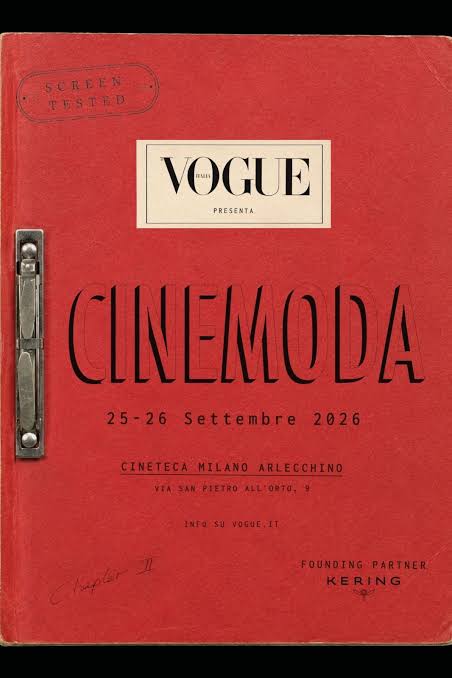
Returning to Milan on September 25 and 26 during Milan Fashion Week, the second edition of the film festival presented by Vogue Italia and Kering transforms Cineteca Milano Arlecchino into a meeting point between fashion and cinema. Curated by Gian Luca Farinelli with actress Chiara Mastroianni as patron, the programme brings together eleven films that approach fashion not as background, but as a cultural language. And that distinction matters.
Why? Because fashion is often discussed through the garment itself: its construction, designer, material, price or season. Cinema allows us to see what happens after the garment enters the world. A dress becomes a character. A silhouette becomes an attitude. A costume becomes a memory. A particular coat, suit or pair of shoes can tell us who someone is before they speak.
Consider Belle de Jour. Yves Saint Laurent’s costumes for Catherine Deneuve did not simply dress a character; they became part of the film’s psychological vocabulary. 8½ carries Marcello Mastroianni’s particular language of Italian elegance. Suspiria turns colour, costume and atmosphere into something almost physical. The Hunger transforms fashion, bodies and nocturnal glamour into an aesthetic of desire and decay.
These films demonstrate something fashion sometimes forgets:
A garment becomes culturally powerful when it means something beyond itself.
This is also why Cinemoda is more interesting than a conventional film retrospective.
Its programme does not attempt to establish a hierarchy between fashion and cinema. Instead, it traces the exchange between them — how cinema has shaped fashion’s visual imagination, and how fashion has helped cinema construct its own worlds. The selection moves between auteur cinema, cult films and documentaries, from Buñuel and Fellini to Godard, Argento, Wenders, Sofia Coppola and Marjane Satrapi.
There is also something significant about the setting.
During Milan Fashion Week, when the city is saturated with runway images, street style, campaigns, presentations and digital content, Cinemoda asks the audience to sit down and watch. To slow down. To look at an image for longer than a scroll allows.
That may be its most contemporary gesture. Fashion has become extraordinarily good at producing images. Cinema reminds us that an image can also have duration, narrative and consequence. And maybe this is where the relationship between fashion and cinema becomes particularly relevant now.
At a time when artificial intelligence can generate garments, models, campaigns and entire visual worlds within seconds, the question is no longer simply how an image is produced. It is what the image makes us feel, remember or desire. Cinema has spent more than a century exploring that territory. Fashion is still living inside it.
Cinemoda, therefor,e does more than bring films to Milan Fashion Week. It places fashion back inside the larger cultural ecosystem from which it has always drawn its power: cinema, art, performance, memory, identity and desire. The runway gives fashion movement. The photograph gives it an instant. Cinema gives it a life.