WHEN McQUEEN CAME HOME
What happens when a fashion house returns to the city that shaped its mythology?
London has never needed to behave like Paris. Its fashion identity was built differently: through subcultures, tailoring, music, art schools, clubs, independent designers and an unusually porous relationship between the street and the runway. It has always been less interested in the idea of fashion as polished hierarchy than in fashion as collision.
This season, that character became visible again. London Fashion Week Spring/Summer 2027 brought together established houses, returning names and emerging designers, but two moments carried particular symbolic weight: Alexander McQueen returning to the London schedule and Christopher Kane making his debut as creative director of Mulberry. Alongside them, Fashion East and the BFC NEWGEN programme continued to foreground younger designers. The British Fashion Council described the September programme as a celebration of British fashion, spanning 47 catwalk shows, 23 presentations and a wider programme of cultural events. The question, then, is not simply what London is showing. It is what London is becoming again.
McQueen returns to its point of origin
Alexander McQueen’s return was more than a scheduling decision. The house had last appeared on the official London Fashion Week schedule in 2001, although it later presented several menswear and off-schedule shows in London. Its return under Seán McGirr therefore reconnects one of Britain’s most internationally recognised fashion houses with the city in which its original mythology was formed. And McGirr did not treat London as a neutral backdrop.
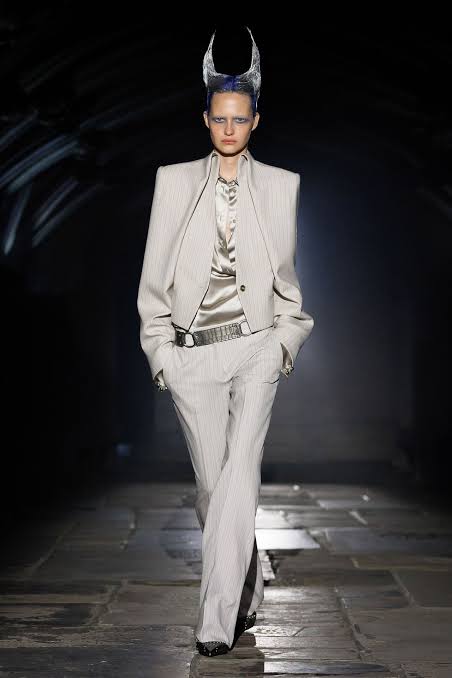
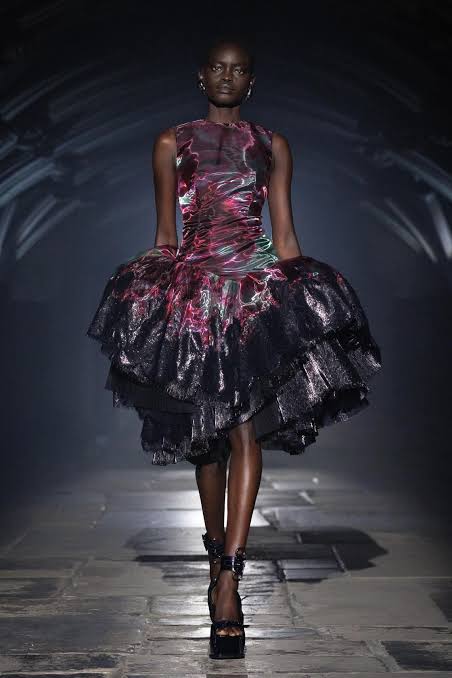
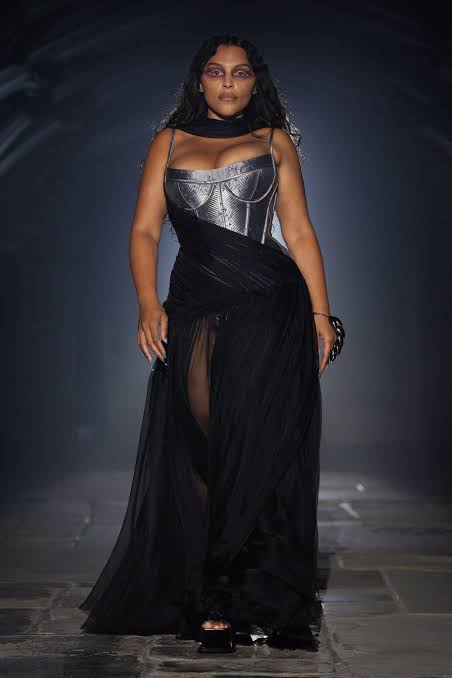
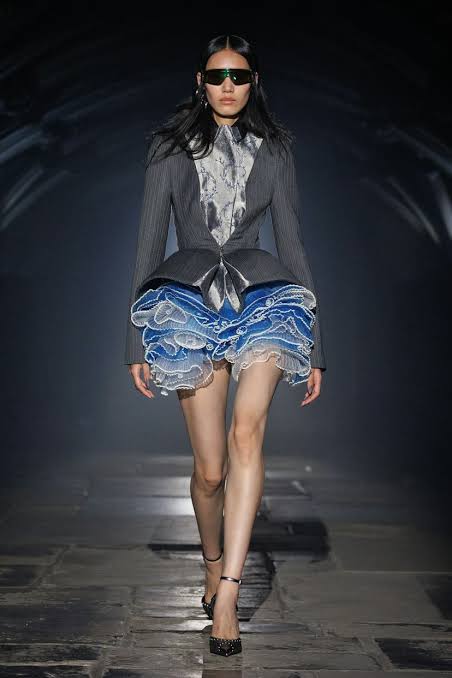
The Spring/Summer 2027 collection was presented at Lincoln’s Inn Chapel, a 17th-century Gothic space. Inside that architecture, McGirr constructed a dialogue between radically different elements of London culture: religious imagery, traditional tailoring, underground nightlife and rave culture. The collection itself operated through contradiction. Tailoring was pushed into sculptural territory. Jackets developed closed shoulders resembling furled wings. Sharp silhouettes referenced Savile Row and Tommy Nutter, while leather collars and exaggerated proportions introduced something more nocturnal and disruptive. Dresses moved between grand, almost classical construction and aggressive interventions: harnesses, distorted bodices, open-backed corsetry and metallic embellishment.
One of McGirr’s references was Piero della Francesca’s The Baptism of Christ, a painting he encountered repeatedly after arriving in London as a young student. Against that almost sacred visual language, he placed the city’s rave culture and the visual memory of figures such as Keith Flint. This is where the collection becomes particularly interesting. McQueen does not return to London by simply reproducing the London of its founder. It returns by asking what London can mean now.
The city as material
There is a tendency to describe fashion capitals geographically: Paris for couture, Milan for luxury, New York for commerce, London for experimentation. But these categories are increasingly unstable. A city does not create a fashion identity simply because designers happen to work there. Its identity is constructed through relationships between institutions, designers, education, nightlife, music, retail, media and the people who occupy its streets.
London’s particular strength has historically been the permeability between those worlds.
McQueen’s new collection makes that permeability visible. Savile Row does not remain isolated from the nightclub. Renaissance painting does not remain separate from contemporary subculture. Formal tailoring can coexist with punk, rave and theatrical distortion.
The result is not a nostalgic reconstruction of British fashion. It is an attempt to understand its contradictions. And contradiction has always been one of London’s most productive fashion resources.
So, the return of McQueen places a major international house back inside the city’s fashion narrative whereas on the other hand Kane’s appointment gives Mulberry a designer whose own history is deeply connected to London’s fashion culture. Emerging programmes continue to bring new voices into the same ecosystem. Meanwhile, the British Fashion Council is explicitly positioning London as part of a broader national fashion network, extending activity beyond the capital through its Fashion Britain initiative across cities including Bristol, Cardiff, Dundee, Edinburgh, Liverpool, Manchester and Newcastle. That suggests something larger than a successful fashion week.
It suggests a fashion system attempting to reconnect its parts. And maybe this is what McQueen’s return ultimately reveals. Fashion capitals are not permanent monuments. They have to continually produce reasons for people to look at them. London’s reason has never simply been luxury. It has been friction, old and new, institution and outside, tailoring and rebellion, heritage and invention.
The runway, in that sense, becomes less a mirror of the city than a negotiation with it. McQueen did not simply come home. It came back to ask what home means now. And London, once again, seems to be answering through fashion.